
2025-26 GDC Fellows

Alex Yong-Kang Chow is a Ph.D. candidate in Geography at the University of California, Berkeley. His research examines the historical and political-economic foundations of Hong Kong’s democracy movement through the lens of affect, geopolitics, and colonial governance. His dissertation traces how successive generations of Hongkongers—from the Cold War era to the post-2019 diaspora—have reinterpreted and contested the meaning of “freedom” across shifting geopolitical and economic conditions. Drawing on archival research, oral histories, and political-economic analysis, Alex explores how colonial institutions, global financial systems, and diasporic networks shape the emotional and ethical imaginaries that sustain democratic aspirations. His broader work engages debates in decolonial thought, affect theory, and the political economy of knowledge production, asking how political ideals such as freedom emerge, transform, and circulate under conditions of displacement, repression, and exile.

Alejo Garcia is a Ph.D. candidate in Environmental Science, Policy, and Management at UC Berkeley. His research lies at the intersection of political ecology, climate and environmental justice, and the uneven geographies of green capitalism. Alejo draws on community-engaged ethnographic methods to understand and support long-standing riverine territorial struggles for agrarian, environmental, and climate justice in the Upper Madgalena River. He is a graduate student affiliate with the Center for Ethnographic Research at the Institute for the Study of Societal Issues, UC Berkeley.

Sharik Laliwala is a Ph.D. candidate in Political Science at the University of California, Berkeley. His dissertation project examines how residential segregation along religious lines shapes India’s urban Muslim political leadership, particularly under the conditions of a spatially confined housing market. For that purpose, the GDC Fellowship supports his fieldwork in the Indian cities of Ahmedabad and Jaipur, as well as his big data work processing India’s Voter Rolls to calculate segregation indices across the country. While his work is topical to India’s marginalized and highly urbanized Muslim community, it will contribute to the study of how minority political leadership evolves in relation to land markets. Before starting his Ph.D., Sharik worked as a researcher affiliated with institutions such as the University of Pennsylvania, Brown University, Sciences Po, and the Trivedi Centre for Political Data at Ashoka University. He holds an M.A. in Contemporary India from King’s College London and a B.B.A. with dual majors in Economics and Finance from Ahmedabad University.

J’Anna-Mare Lue (she/her) is a Civil and Environmental Engineering PhD candidate with an environmental engineering focus. She is interested in the reparative capacity of engineering in thinking through questions of climate justice in the Caribbean. J’Anna is interested in the ways colonial legacies have influenced built, natural, and social infrastructures in Jamaica, which in turn impact communities’ ability to cope with the realities of climate change.

Jasmine Hiroko McAdams is a PhD student in UC Berkeley’s Energy and Resources Group. Her work explores the infrastructures of and for imagination, including the material, digital, and civic systems that shape how societies envision and enact equitable futures. Through her dissertation, she is examining how data centers, energy systems, and participatory civic practices mediate collective imagination, belonging, and world-building.

Srihari Nageswaran is a PhD student in the Department of Anthropology at UC Berkeley. His prior research examined the relationship between India’s model of quasi-federalism and regionalist political mobilization in its southernmost state of Tamil Nadu. His tentative dissertation project leverages the tools of economic anthropology, critical geography, and South Asian studies to examine special economic zones in Chennai. Before joining Berkeley, Srihari received a Bachelor of Arts in Anthropology with honors and distinction at Stanford University.
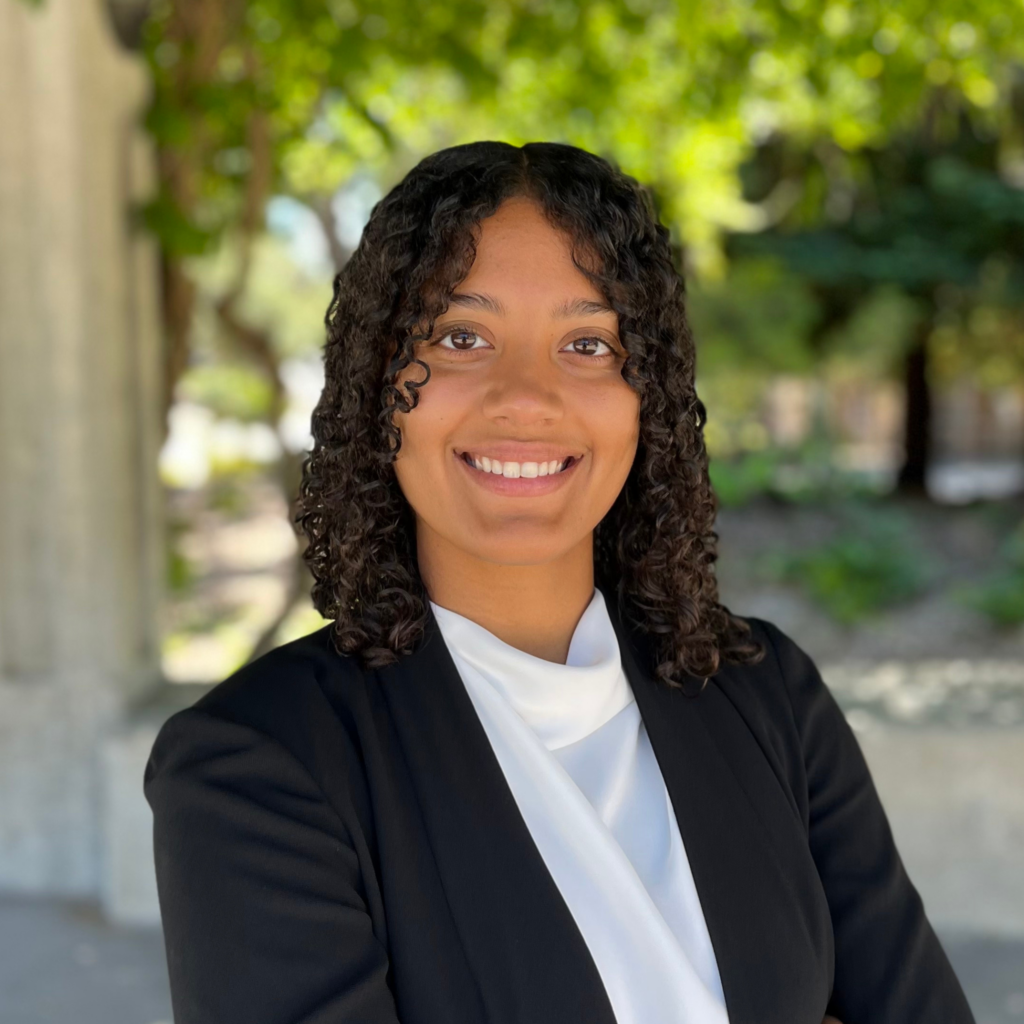
Anna Palmer is a Ph.D. student in the Department of Sociology at the University of California, Berkeley. Her research examines the convergence of extractivism, (post)colonial development, and the climate crisis in the Caribbean through a qualitative and spatial lens. Her current work focuses on political decision-making and resistance to oil extraction in Guyana through content analysis and interview methods. She holds a BA in sociology from Occidental College.

Ailén Vega’s work looks at an emerging movement against mercury contamination from illegal gold mining within Munduruku territory, situated within Tapajós River Basin of the Central Brazilian Amazon. She is particularly interested in the relationship between indigenous and western scientific knowledge practices in evidencing harm from chemical exposure within one of the most heavily mined indigenous territories in all of Brazil. Funding from the GDC allowed me to carry out follow-up research in collaboration with the Munduruku organizations I work with, consulting them on sensitive ethnographic matters and the progress of my research during the dissertation writing phase.

Carolina De Wit is a third-year PhD student in History at UC Berkeley. My research focuses on the history of deviance, crime, and punishment in 19th—and 20th-century Brazil, it examines the intersection of legal medicine and social control, exploring how Brazil’s political elites used medical science and criminology to pathologize deviant behavior, framing it as a threat to public health and national development.